Intumescent mastic
The tube of red or grey sealant you see round cables and joints. It only works at the right depth.
- Every seal labelled and photographed
- BM TRADA / FIRAS-certificated contractors
- Written price before any work
Intumescent mastic looks like ordinary sealant from a gun. It swells when heated and seals the gap. Acoustic fire mastics do a similar job and also cut sound.
It is the right product for small things. A single cable. A small copper pipe. An open joint in blockwork. The edge of a batt.
It is the wrong product for a big open hole. Mastic on its own is only tested up to certain gap sizes.
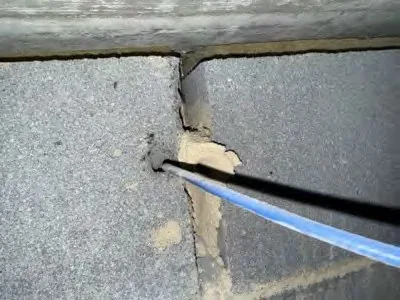
The photo on this page
A single blue cable goes through a block wall at a school we worked on. Next to it, the mortar joint has opened up. That is two jobs for mastic: round the cable, and along the joint.
Depth matters most
The test evidence for a mastic gives a depth. Often it is something like 15mm or 25mm, with a backing rod of mineral wool behind it in a deeper gap.
A thin bead across the surface of a 100mm wall looks finished. It is not to the tested detail. On a survey it would fail.
So a typical sequence for an open joint 10mm wide in a block wall:
Joint cleaned out. Mineral wool packed in as backing. Mastic gunned in to the depth on the data sheet. Smoothed. Same on the other face if the test says both faces. Photo. Tag.
Colour
Many fire mastics are red or pink so they stand out. Grey and white versions exist too. Colour does not tell you whether it is fire-rated. Some red sealants are not. The tag and the record tell you.
Who fits it
Our BM TRADA / FIRAS-certificated contractors. Every bead that closes a gap in a fire wall goes in the record with a number.
Tell us the postcode, what the building is used for and how many floors it has. Photos of the gaps help a lot.